“Hammer House of Horror” can be seen as the last offering from Hammer Studios, at least in their classic period. It ran for one season of thirteen episodes, each one telling a different horror tale. While none of the episodes were bad, there was some variety in quality as there is with any television. In this article I will talk about a few of my favourites.
Rude Awakening
Denholm Elliot stars as a real estate agent who seems to be having an affair with his secretary (called Lolly!) He is given an address of a property to be sold, and he goes to make an appraisal. He finds the place falling down, and then hears a voice saying ‘you shouldn’t have killed your wife’, whose body then falls out of a dumb waiter. But he wakes up in his bed, and it was all a dream. The story continues with the man experiencing increasingly strange events and his secretary in a variety of outlandish outfits, only to wake up in bed each time from a bad dream. After a particularly unpleasant one where he is told he has a brain tumour, only to be wide awake and aware while the people around him say he is dead and put him in the morgue, he wakes up and smothers his wife, believing he is still dreaming so there are no consequences. He then heads off to his office happily, telling his secretary that he is finally free to marry her. Unlike the other times the secretary is not dressed outlandishly, is not overly familiar with him and is extremely disturbed by his statements and the necklace he insists on giving her. Eventually a police inspector and sergeant enter the building, and the inspector seems to be the same man who gave him the address of the property in the first dream. The man cheerfully admits to killing his wife, as it is a dream. However, it appears that he is no longer dreaming, and he is arrested.
This reminded me of the older horror movie ‘Dead of Night’, an anthology movie that has as its framing device a man who has the same dream over and over. Elliot is, of course, superb in the main role and very convincing as he gradually loses his mind, ultimately having no idea of the difference between dreams and reality. The audience, going along with him, is not sure either, until the end, where the warnings about killing his wife come true. It is cleverly written and directed, and keeps the viewer wondering and guessing right til the end.

The House that Bled to Death
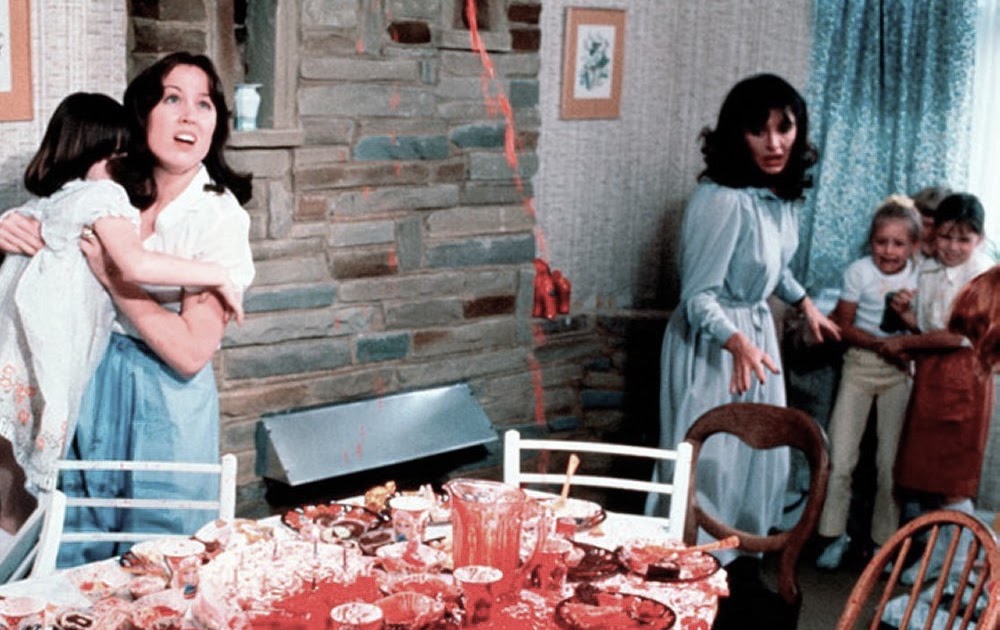
A couple move into a house that was the site of a previous murder. Strange events start to happen, including the appearance of the blades used in the previous killing, the death of a cat, and a shower of blood spraying children at a birthday party of the couple’s daughter. Eventually the couple (apparently) flee from the house. However, it appears that the couple were in league with the seller of the house to create a haunting, that he could write about and they could split the proceeds. This has made them well off and they are now comfortably living elsewhere. It also eventuates that they were not initially a couple – the woman and her daughter had only just met the man, and then he recruited the woman into the scheme. The couple get their comeuppance, however, when their traumatised daughter (now a few years older) finds out that the trauma she went though, including the death of her much-loved cat, was down to her mother and the man she shacked up with, who both blithely assumed she would ‘get over it’. She didn’t.
I think this is a really good episode because it’s not at all what it appears to be, what the viewer assumes it to be. The spooky events are a hoax, and the actual horror is all too real. There were good solid performances by all the cast and the direction kept you guessing. It seems an obvious haunting story and it isn’t that at all. I love the twist.
The Silent Scream
Peter Cushing stars in this episode, his last appearance for Hammer Studios. He plays a pet shop owner who does prison visitations, and befriends an inmate played by Brian Cox. When the felon is released he goes to see the pet shop owner, who offers him money and a job working in his private zoo. This seems like a great opportunity, but it really isn’t. The pet shop owner mentions his experience in concentration camps. Naturally the viewer assumes he is speaking from experience as a prisoner himself. This assumption is wrong and leads to an inescapable trap that captures the ex-con, his wife, and the Nazi himself.
This is the best episode of the series. Peter Cushing’s performance is, as always, fabulous. His character is devious and clever, and apparently thinks of all possible outcomes, covering all eventualities. Cox also does a fine job as the claustrophobic prisoner, absolutely distraught at the very idea of being in prison again. I don’t want to give away the ending on this episode – it has to be experienced, and it is superb.Let’s just say that while Cushing’s character achieves his goals, he also becomes caught in the same trap.

Guardian of the Abyss
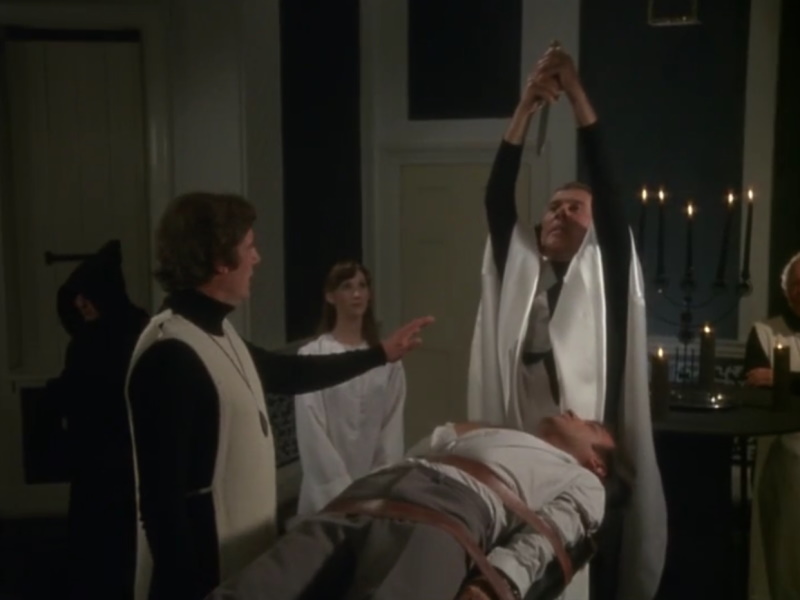
After an antique mirror turns up at an auction, a girl on the run from a cult claims it is a scrying glass that can summon ‘Chorozon’, a demon. Members of the cult are in pursuit of the glass and the girl who they apparently mean to sacrifice. A rival dealer who offers to buy the glass turns out to be a member of the cult, and there are various twists and turns in a surprisingly involved plot. In the finale of the episode, the hero finds out that picking up girls on the run from cults is probably not great for your immortal soul.
This episode is very reminiscent of classic Hammer. While it is set in the modern day, its depiction of witchcraft and black magic put me in mind of movies such as “The Devil Rides Out”. It also has an appearance by Paul Darrow, best known for his role in the tv show “Blakes 7” (a childhood favourite of mine.) It is a surprisingly complicated plot for less than an hour, but it achieves this with good pacing and no wasted moments.
“Hammer House of Horror” was a fun watch for spooky season in October, and I enjoyed it immensely. I would recommend it to Hammer horror fans particularly, and anyone who likes their horror with suspense rather than spectacle.
 Eclectic Assemblage