John William Waterhouse was a later painter of pre-Raphaelite style, which started in 1848 with the formation of the pre-Raphaelite ‘brotherhood’. However, his work was different in many ways from the first painters in that style, being more three-dimensional. His subjects included Arthurian and similar tales, classical tales, and more general subjects. Some of his works touched on Symbolist painting. Waterhouse may have come to the pre-Raphaelite style after it had gone out of fashion, but his own unique take on this meant he enjoyed a respectable career during his life, and his work is still loved long after his death.
An example of the difference can be found if you look at the work of founding Pre-Raphaelite member Dante Rossetti. His works are more in keeping with the Pre-Raphaelite idea of Medieval inspiration in their composition. As such Waterhouse’s work seems freer, more dynamic. If you compare each artist’s depiction of The Annunciation, you will see interesting similarities and differences. Unlike medieval works on this subject, both artists have depicted Mary looking less than delighted about it all. In both pictures, the angel presents Mary with a white lily, which is a traditional symbol for Mary. According to the Gospel of Luke, Chapter 1, Mary was ‘disturbed’, ‘greatly troubled’, ‘startled’ (depending on the translation). Suffice it to say, she was not instantly accepting of the situation, and both artists can be commended for depicting this. But there are massive differences as well. Rossetti’s picture is quite bare and unadorned. Mary huddles on her bed, while the angel offers her a lily. The angel’s face is barely visible and interestingly, there are no wings. The picture has little depth, no doubt in keeping with the medieval tradition where perspective was not used. Waterhouse’s version is much more animated. There is certainly depth to the scene, which is taking place outdoors. There are stairs leading up to a house, a stone pavement, grass growing up around the legs of the angel, a wall, trees. It is very much set in a three-dimensional space. Mary is kneeling, but with one hand to her chest, the other clutching at her hair, as if on the verge of panic. The angel is again seen only in profile, but his richly coloured wings match Mary’s dress. He also offers her a lily. The only real concession to Medieval style painting I can see in this picture is the flat disc haloes at the back of each character’s heads. To me the Waterhouse painting is much more interesting and vivid than the Rossetti painting. It’s colours, depth, and depiction of the characters is much superior.

“The Lady of Shalott” is a personal favourite of mine, and in fact I have a print of this hanging on my wall. Based on the poem of the same name by Tennyson, it depicts the moment after the Lady has triggered the curse she is under, and takes to her boat to travel to Camelot. The boat is depicted as lined with beautiful tapestries, and is magically steered towards its goal. The lady sits in the boat singing her last song, her long hair loose and wearing a beautiful white gown trimmed with gold. Her mournful face and sad eyes depict this moment perfectly – she knows she will be dead by the time the boat reaches Camelot.
A longdrawn carol, mournful, holy,
She chanted loudly, chanted lowly,
Till her eyes were darken’d wholly,
And her smooth face sharpen’d slowly,
Turn’d to tower’d Camelot:
For ere she reach’d upon the tide
The first house by the water-side,
Singing in her song she died,
The Lady of Shalott.
Waterhouse depicts the river, the boat, and the reeds with almost photographic precision. I couldn’t really explain why it’s always been a favourite, I just find it emotionally compelling.

“La Belle Dame sans Merci” (‘the beautiful lady without mercy’) is a painting inspired by the poem of the same name by John Keats. The lady has used her hair in this picture to ensnare the knight – she has wrapped it around him like a net, dragging his face towards hers.
La Belle Dame sans Merci
Hath thee in thrall!
The painting mirrors the poem in its depiction. This fairy woman has caught him and he is lost. Her red hair is extremely long and loose, and her dress is detailed and beautiful. The knight is in full armour and still is helpless against her magic.

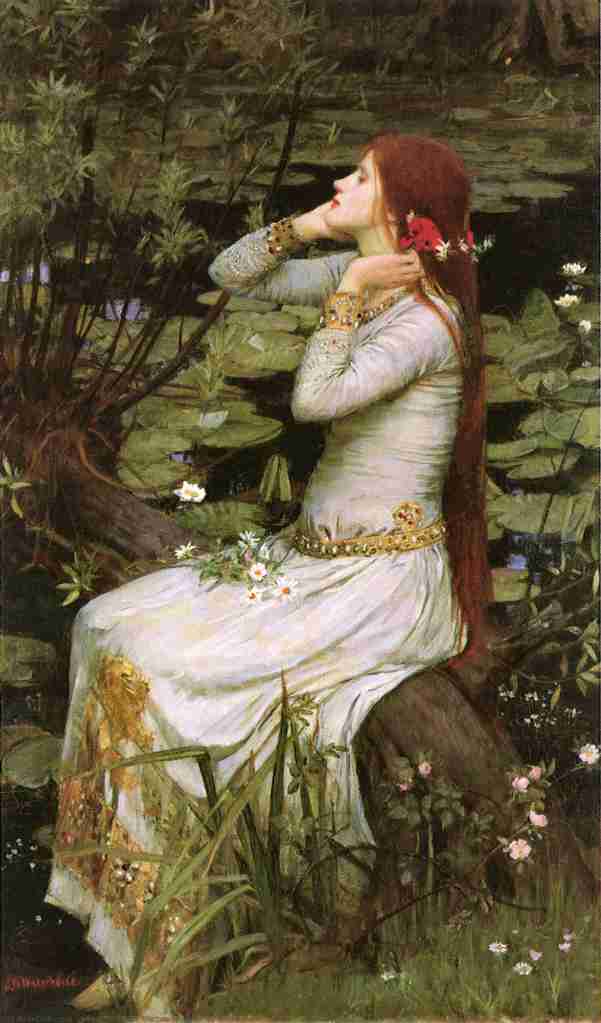
Turning now to Shakespeare, Waterhouse painted “Ophelia”, a favourite topic for many artists. Ophelia in “Hamlet” eventually drowns after going mad. Waterhouse’s painting depicts her shortly before her death, sitting on a willow branch over the water. She is dressed richly as befits a noblewoman, but her lap is full of flowers and she is weaving them into a wreath.
There, on the pendant boughs her coronet weeds
Clamb’ring to hang, an envious sliver broke,
When down her weedy trophies and herself
Waterhouse has chosen to depict the moment just before her fall into the water, where she is oblivious of danger and making flower wreaths for her dead father. The painting includes lilies in the water behind her, and again the woman is depicted with long, loose hair. I love the detail of gold and jewels at her wrists and belt.
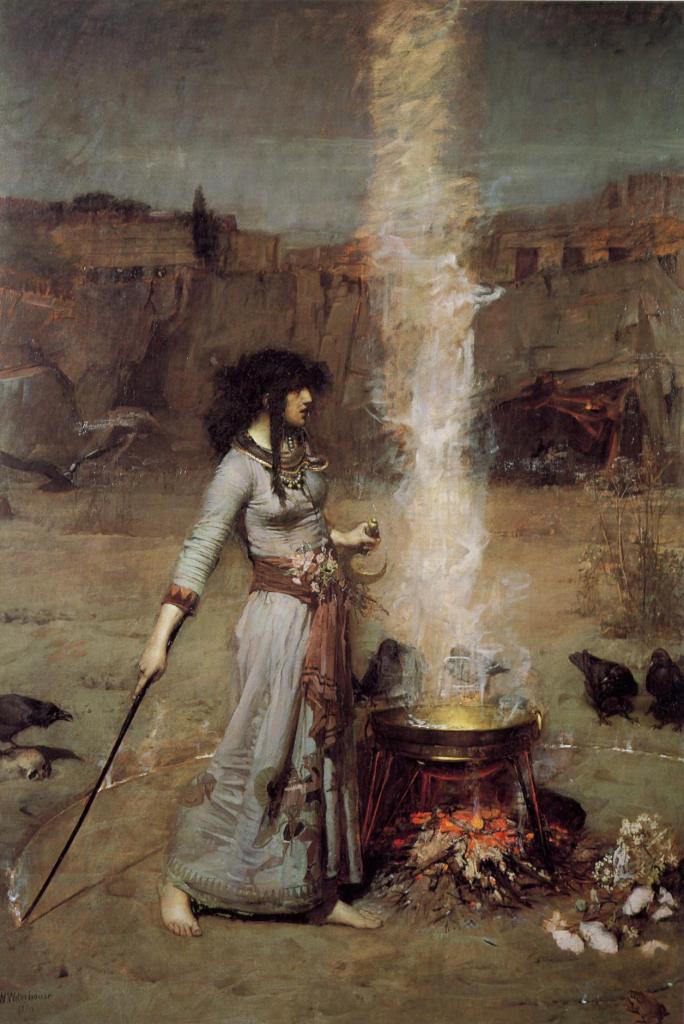
“The Magic Circle” does not depict any specific character from myth or story, just a more general mythological theme. A witch stands over a cauldron, drawing a magic circle around herself with a wand. There are birds, ravens possibly, on the ground grouped around the cauldron. The witch grips a sickle in her other hand and there is a live snake looped around her neck. A point of interest is that there are buildings on the cliffs in the background, so she is not hiding away in the wilderness to cast her spell, it is right near where there are people, indicating that the work is known to the town’s inhabitants. She has no air of malevolence or evil, only an expression of concentration on her work, and does not seem to notice her bare feet are alarmingly close to the fire. As the column of smoke is going straight upwards and not billowing outwards the viewer can assume the spell is going well. The witch’s surrounds are shadowy, hard to make out, which fixes our attention on the central figure of the witch herself. So it is hard to tell if she is being observed from the town on the cliff or not. This is a very compelling picture, and you get a real sense that the woman is a person of power.
In conclusion, I love Waterhouse. The detail, colour and ambience of his works really speak to me. His subject matter is to me a great deal more interesting than portraits or still life – they depict stories and characters. Sometimes the stories are known, such as in ‘The Lady of Shalott’, sometimes they are not, as in ‘The Magic Circle’. But either way you can look at what is happening and think about what has happened before, what will occur next. I enjoy art that depicts moments as part of a greater narrative, and invites the viewer to consider that narrative. Waterhouse’s work excites the imagination.
 Eclectic Assemblage