‘Peanuts’ is probably one of, if not the most famous comic strip in the world. Running for a whopping fifty years (1950-2000), it was written and illustrated by Charles M Schultz. According to Wikipedia (https://en.wikipedia.org/wiki/Peanuts), ‘Peanuts’ was a title foisted upon Schultz and he hated it, declaring it made no sense. Maybe not, but it has become synonymous with the faces and hilarity of the characters ever since.
The world of Peanuts is a world of children. Adults are present in their lives but are not seen in the comics (save a few early strips before Schultz dispensed with this altogether.) They are always ‘off-screen’, and you see the children speaking to them and answering them, but no adult voices intrude. (The cartoons when made introduced musical ‘wahwah’ notes to simulate adult speech, which is both hilarious and possibly indicative of how much small children are paying attention anyway).

Charlie Brown, the main character, is a hapless, neurotic child who seems perpetually doomed to failure. He doesn’t win at baseball, he doesn’t do well at school, he can’t fly a kite properly (it constantly ends up in one particular tree), and he cannot work up the nerve to speak to his crush the ‘little red-headed girl’. But Charlie Brown is often kind, a good friend, cares about and looks after his dog, and tries to be a good big brother to his sister Sally. He is constantly depressed, a concern he expresses to Linus and Lucy. I have often found myself wanting to give Charlie a big hug over the years. Schultz said Charlie represented him, but I think he represents all of us, with all our hopes and fears. I have often found myself relating more than I liked to his feelings and failures.

Snoopy is Charlie’s dog, and I can safely say he is the most popular character. He’s certainly my all-time favourite character of this or any comic strip. Snoopy’s endless fantasies keep him entertained, and his person Charlie Brown endlessly perplexed. Snoopy plays at being a World War 1 flying ace, perpetually hunting the Red Baron on his doghouse substituting as his plane. He always likes on top of his kennel instead of in it, and if the weather is not right for this he will often con Charlie Brown into letting him inside. His other fantasies include a world-famous ice skater, world -famous author, Easter Beagle, Joe Cool, world-famous attorney, world-famous astronaut, head Beagle, Cheshire Beagle, and so on. Snoopy also takes Woodstock and his friends on trips as ‘Beagle Scouts’, leading to some hilarious adventures. He is constantly getting into trouble with his imaginings, but never gives up. Everyone loves Snoopy (except possibly Lucy.) He is a free spirit, living in his own (mostly untroubled) world.

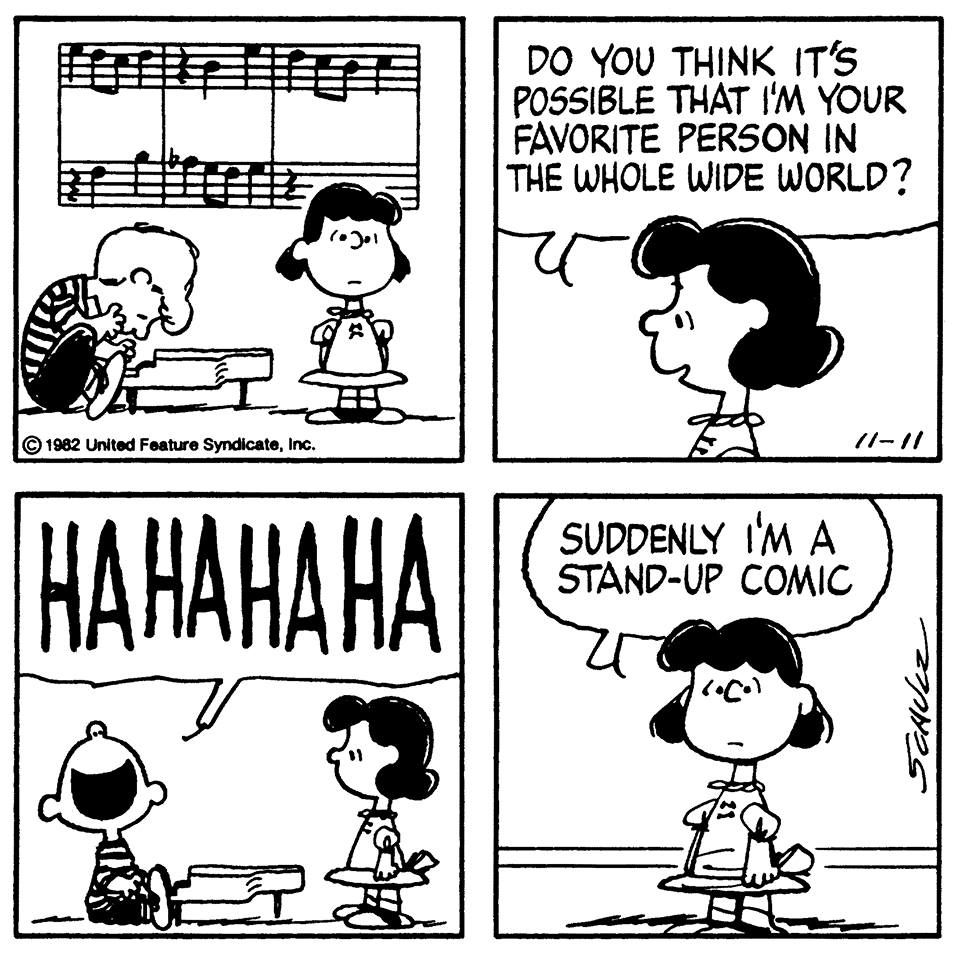
Lucy has been often named ‘Miss Fussbudget’. The dictionary defines a fussbudget as a person who complains and fusses about unimportant matters. Lucy’s constant complaining makes her a good candidate for the title. She is also something of a bully, to her brother Linus and to Charlie Brown. She has a crush on Schroeder and is constantly hanging around while he is playing piano, much to his annoyance. She is a take-charge person, and likes to manipulate events to her own ends, finding money-making ventures along the way. But while most kids might set up a lemonade stand, Lucy sets up a psychiatry stand, a session for 5 cents. Charlie Brown does appear to be her main client, though why he keeps on giving her money for no help is a bit of a mystery. That being said, she has been known to dispense good advice occasionally, and is also confident, strong and brave, sure she’ll make a great president someday.

Linus, Lucy’s brother, is my second favourite character. He appears to be in many respects the most intelligent of the characters, though he is not free of his own quirks and neuroses. Principle among these is his security blanket, which he takes everywhere. He would appear to be past the normal age for a security blanket but is unable to discard it. Snoopy, fascinated by the blanket, is constantly trying to steal it, but doesn’t usually succeed. Linus has also (one assumes due to a child mixing things up) has concluded that the ‘Great Pumpkin’ will rise out of a pumpkin patch and give presents (a la Santa Claus) to all good boys and girls on Halloween. He clings to this belief in the face of many disappointments, showing a tenaciousness and a superior level of faith, even if it is in an incorrect subject. However, he seems to be an old soul in many ways, dispensing wisdom and sound advice.

Schroeder, the musician, plays magnificent music on his toy piano. (Given the painted n keys, how he does this is a mystery.) He is obsessed with Beethoven and tells everyone when it’s Beethoven’s birthday. He is often being annoyed by Lucy, who hangs around pretending to like his music because she has a crush on him and goes on about how they should get married. Schroeder usually shuts that down very quickly. He is also occasionally bothered by Snoopy, who does seem to genuinely enjoy the music. Schroeder’s obsessive focus on classical music has led some to regard him as autistic, however I don’t believe Schultz intended him to have any ‘diagnosis’, rather that he was another character who was doing things kids do, like obsessing over a favourite activity.
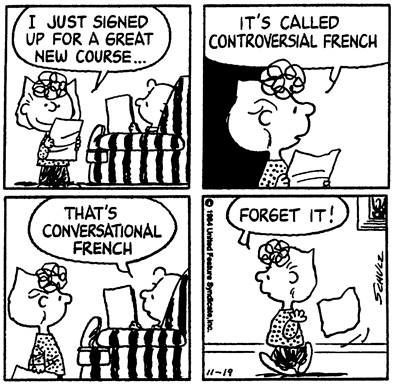
Sally is Charlie Brown’s little sister. While she does not have the sheer bad luck that seems to plague her brother, Sally has her own collection of peculiarites. She has a very odd way of looking at things that has been known to get her into trouble at school. She wants to do activities that are different and is less interested in normality. She also has a crush, on Linus, who she is constantly calling her ‘sweet baboo’. (Linus’ strong objections to this go unheeded.) She has an impressive skill at general ranting and raving, which is hilarious. She is sweet and innocent on one hand, while underneath there is a strong cynical streak. Sally sees truly through the nonsense of the world and understands how things often make little sense.
The Peanuts gang have stood the test of time because their personalities are so relatable. They have something to say even now, over seventy years after they first appeared. The different aspects of each character each have something we can relate to, and that is one of the reasons Peanuts is still so popular today. The other reason is, of course, that it’s hilarious.
 Eclectic Assemblage