Edward Hopper, (1882-1967), an American ‘realist’ painter, was known for his pictures of isolation, loneliness, disconnection. His pictures are full of emotion and tell stories that invite multiple interpretations. There is always something new to find on every viewing.
“Automat”
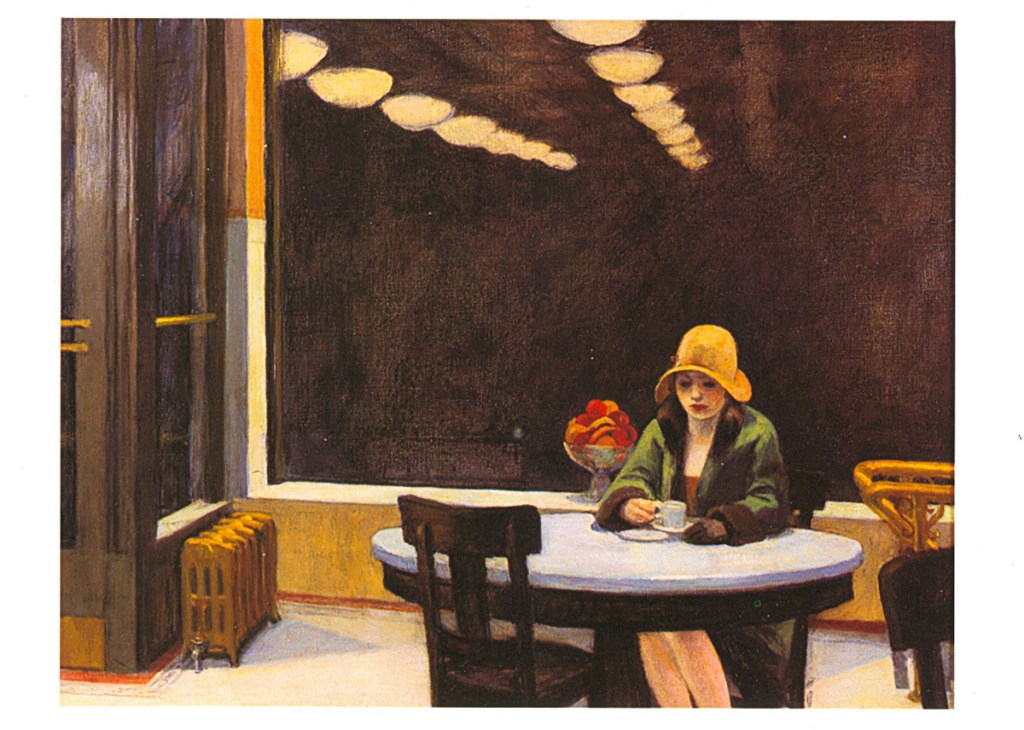
While vending machines are common, at one time there were eating places called automats, where all food was served by vending machines. We only know that the place in the picture is an automat due to its title – there is no vending machine to be seen. There is a table with two seats. A woman sits alone, her back to a window. Lights from this interior are only seen as reflections in the window. Outside it is night. The edge of a door can be seen on the left, with an oil heater near the wall. To the right are the edges of more chairs. There is a glass bowl on the window sill behind her, maybe fruit. What can be seen of the room is otherwise featureless.
She is drinking coffee, looking down at the cup as if it is the most interesting subject in the world. It’s a cold night, as she wears a coat with fur collar and cuffs, and gloves. She has taken one of them off to drink her coffee. The pout of her lips and her downcast face speak volumes. She is sad, very sad. The coat is nice, and under the coat what she is wearing seems quite low cut. Is she dressed for an evening out? Is she meeting someone? The empty chair speaks volumes – has she been stood up? Or is there another reason for her apparent sorrow?
The white floor and the black glass at her back accentuate her isolation. Whatever the cause of her dejection, she has to deal with it alone. Her clothes are bright – yellow hat, green coat, red dress. They stand in contrast to the bleak and unadorned surroundings. Her expectations have not been met. So, in the end she is alone on a cold night with only a cup of coffee for company. I want to give this girl a hug.
“Shakespeare at Dusk”

This picture is more tranquil than much of his work. It depicts the statue of Shakespeare that stands in Central Park, New York. Despite the title, the artist has made the unusual decision to put the statue at the left of the picture, with the view of the statue from behind. The viewer of this picture can see what the artist sees, the tranquil surroundings of the park, the cityscape in the background, the last of the daylight in the orange of the sky. There are no people walking through, nothing except nature and city in an unusually harmonious juxtaposition.
The white path leads us to the statue, and then around and through the contrasting grass, through the trees, to the city beyond. It is a liminal picture in a way – the two lamps that stand in the central area of the painting are not yet alight, but with the fading daylight they will be soon. So Shakespeare contemplates New York between day and night, and stands at the crossroads of different paths, different journeys.
“Gas”
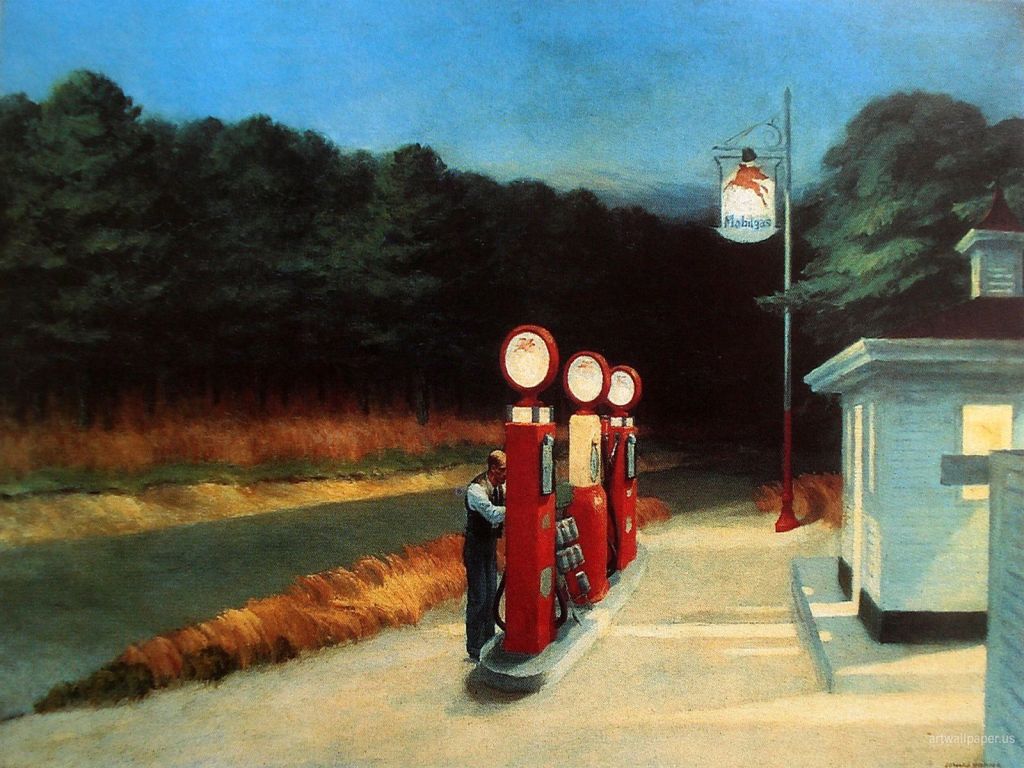
On a lonely country road in the evening light, there is a gas station. Bright red pumps are out near the roadside, with a small white building to the right of the picture. Gold-coloured grass lines the verges, with a wood of dark green trees behind. The pool of illumination offered by the building is small, and beyond that the road swiftly disappears into impenetrable darkness. One man, the gas station attendant, stands at one of the pumps, performing some kind of maintenance we assume. There is no traffic on the road.
Out of curiosity I googled American petrol stations of the era, and this is most certainly an accurate depiction. It also is a sign of its times (painted in 1940) that the employee is wearing a waistcoat and tie. The outfit seems incongruous to today’s viewer for such employment, but those were different times. One could almost wish the painting showed the price of the petrol.
There is no way really to tell how far from civilization this is, but the road looks very lonely. Having driven isolated roads in my country, it is reminiscent of dark highways, the lamps on high beam lighting up road and trees, grass and sky, and only yourself for company. I wonder how many customers an employee like this would see in a night. I wonder if the station is open all night (if they did such things back then) or if he got to go home eventually. I wonder if he was ever spooked by the dark, or wondered how long, if something happened to him, it would be before he was found. Maybe he was grateful for a job, given the time this was painted, but it seems so very unsafe to me. It feels as if he is cast out, exiled from the city and from people.
“Nighthawks”

This is easily the most well-known of Hopper’s work. It depicts a diner, at night. The building façade is almost entirely windows, allowing an open and easy view of the well-lit interior. There is a counter, wooden, a server behind the counter, stools, and three patrons, a couple on one side, and a single man on the other. Coffee cups, salt and pepper shakers, and napkin holders are interspersed on the counter. There is a sign on the exterior of the diner above the window, but there are no interior decorations visible, just a bland yellow wall. There is no sign of an entrance.
The nearby buildings all seem to be shopfronts, but they are all closed. This plus the complete absence of anyone on the footpath, or any car passing, indicates this is quite late at night. Curiously the empty shops seem as featureless as the diner, without any decoration or advertisement. The light that spills out from the diner illuminates emptiness. Nothing is there.
The single man can only be seen from the back. His head tilts slightly forward, and he might be gazing at the counter. He might have food or drink, but we cannot see it. There is no indication that he is doing anything at all, just sitting.
The couple lean on the counter, smoking. The garish light gives them an equally garish appearance. The woman’s lipstick, her red dress and red hair. are the only points of bright colour, but they are swallowed up in the overall blandness of the scene. The bright light and yellow walls serve to make the complexions of the couple a sickly yellow as well. Neither of them look happy. It doesn’t seem as if they have had an argument – the woman doesn’t look like she cares enough about to do so. She looks jaded, tired.
The server is bent forward, obviously busy at some activity. He is, however, looking up at the man. He seems hesitant. His face looks wary, concerned. The man is looking in his direction, perhaps directly at him, it is hard to tell. He looks tense, irritated, his lips compressed and thin. Whatever he has said has made the server nervous.
This painting reeks of alienation. An empty diner in an empty street in an empty city, where sensible people are probably in bed, and containing four people who, in spite of the necessity of interaction, seem just as isolated. The wide open windows and lack of a visible door give the diner an appearance of a goldfish bowl. If someone were to pass by they could look in and see everything that is going on, and without being seen as long as they stayed out of the light. It reminds me of a film noir setup, with this the stage that is set just before the action starts. However, here there won’t be any action. We are the audience, standing outside of the light, but there is just the isolation of individuals in stasis. Nothing is going to change.
“Two Comedians”
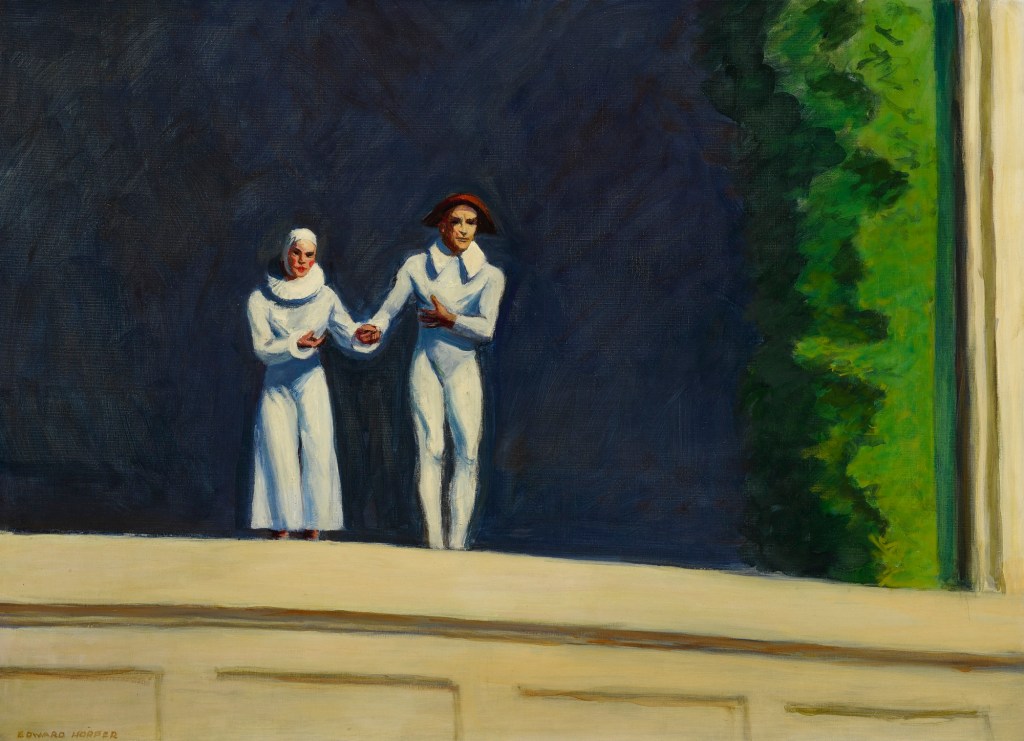
A man and a woman, in white costumes reminiscent of Pierrot and Pierrette from Commedia dell’arte, stand on a dark stage. They stare down at we, the audience, holding hands and gesturing towards each other as if to indicate their love and appreciation. The stage is dark, with no set, only the two comedians, bowing their exit.
This was Edward Hopper’s last painting, and he would die within two years, followed by his wife a year later. This painting is a strong indicator of his awareness of mortality and serves as a final chapter to an impressive body of work over his life. So much of his work dealt with our disconnection from the world and from each other, but here he seems to remind us that we do not have to go through the world entirely alone. We can find companions to journey with us, and for Hopper, it was his wife.
It’s a plain picture and is meant to be. There is no backdrop to the stage because the show is over. The players are saying goodbye, and departing into the next adventure, the next world. Their love has held in a world where so many are isolated, alienated, completely alone. We are surrounded by people, but how many people do we really connect with?
Edward Hopper painted the disconnection and detachment of human beings in a world of noise and disillusionment. He had a profound understanding of the pain of isolation, the fear of being other, perpetually outcast. He also understood how important it was to find a connection and share the long road with other souls. His work tells a million stories, always meaningful, often sad, and occasionally sublime.
 Eclectic Assemblage