Johannes Vermeer was a Dutch painter of the sixteenth century. He lived his entire life in the city of Delft and is known mostly for his paintings of domestic household scenes, mostly using the same rooms inside his own home. He’s been called the ‘master of light’, though that title has been given to a few artists. He may have been influenced by the Italian artist Caravaggio, who pioneered Baroque painting and was known for his use of ‘chiaroscuro’, strong contrasts of light and shade in a painting. However, Vermeer did not paint the same dramatic subjects of Caravaggio and many Baroque artists, opting on the whole for quiet home life as the subjects for his work. I have chosen four paintings of Vermeer’s to talk about.
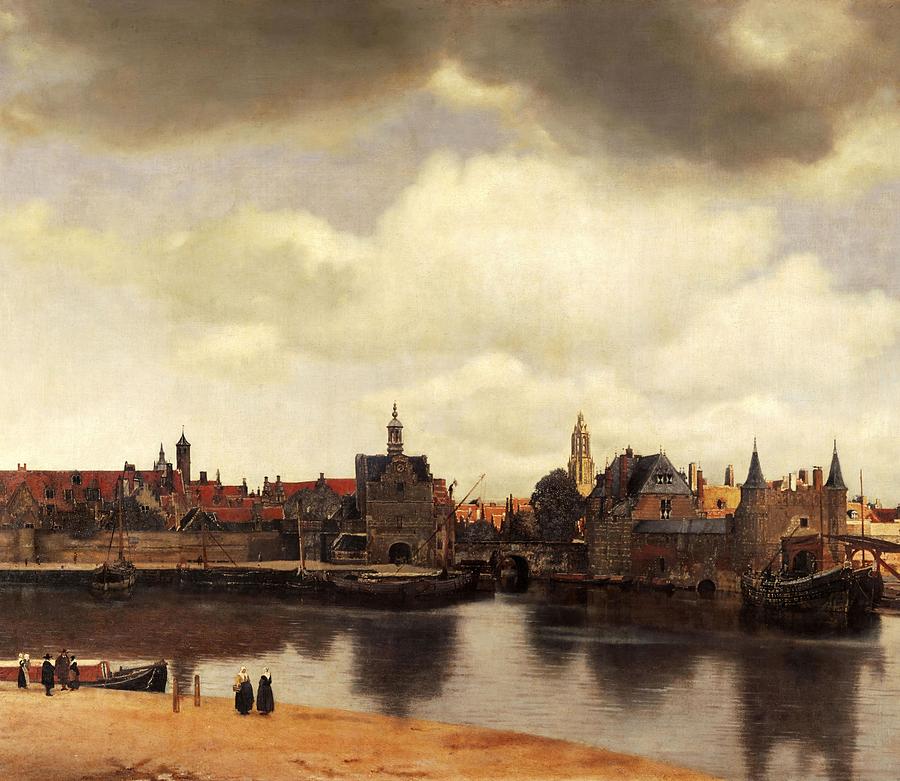
“View of Delft”
It’s a cloudy day at the riverside. Boats are moored by the bank. The town is viewed from across the river, with red roofs, dark brick buildings, and ornate features such as towers and spires clearly visible. The lighting is diffuse, and the buildings cast indistinct and rippling reflections on the water. It’s hard to make out any people on the far bank. On the near side there are two woman standing having a conversation, whilst a small group gathers near one of the boats. They might be about to embark, or alternatively have just come from the boat. It’s a surprisingly deserted scene for a riverside – one would expect more activity. Is it Sunday? Vermeer seems to be more focused on the buildings in this painting, with the vista of the city’s architecture and the boats moored peacefully. Your eyes roam over the city view, and the flow of the river. Unlike much of his work, which is very much person-centric, Vermeer seems to want to leave the people behind this time, and just look at the city. As with all his paintings, the attention to detail is superb. Despite the apparent distance, you can still make out brickwork, boat timbers, details of spires and towers, the white headdresses of the women in the foreground. It seems an affectionate picture to me, showing the artist’s love of his home.
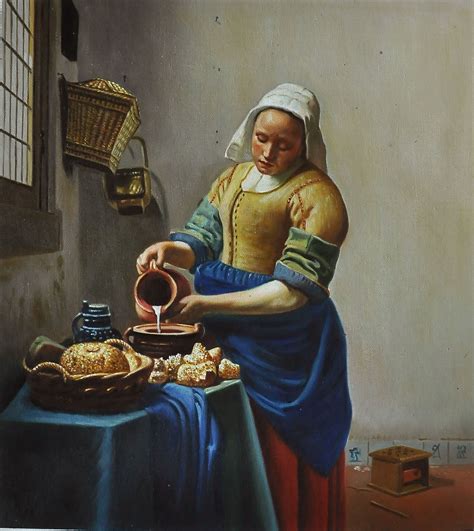
“The Milkmaid”
The title of this painting is something of a misnomer, as the woman in the picture is actually a kitchen maid, who is only termed a milkmaid because she happens to be pouring milk. She pours milk from a jug into a bowl. She appears to be making bread pudding, as crusty bread is on the table and in a basket. With Vermeer’s usual detail, the seeds on the bread crust are clearly visible, as is the stitching on the woman’s bodice. This room (a kitchen or pantry) is clear and well-lit. Other baskets hang from hooks on the wall. The woman’s sleeves are rolled up, a blue apron is hitched up at her waist. There is an ornate blue mug also on the table, and a footwarmer on the floor at the bottom right of the picture, suggesting it’s a cold day. The folds in the woman’s dress and the cloths bundled on the table are clearly depicted, and the painter makes a vivid contrast of the red with the blue. Blue and white tiles line the bottom of the wall, traditional Delft ceramics. Vermeer doesn’t skimp on the small details, no matter what he paints. This makes the scene, a candid moment in an ordinary day, all the more vivid.
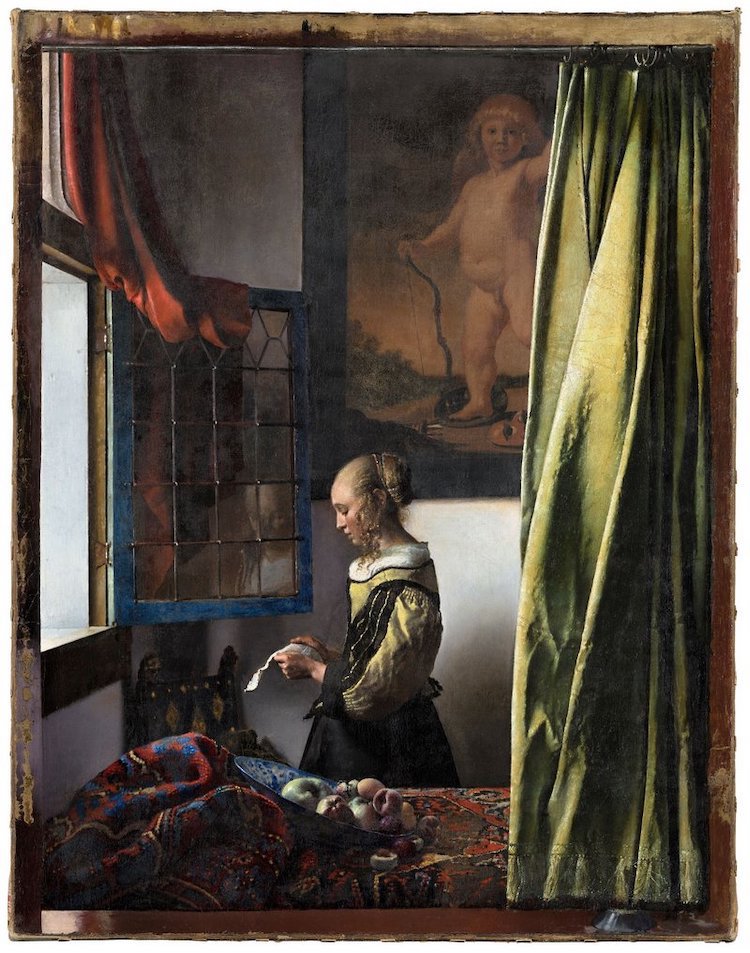
“Girl reading a letter at an open window”
The curtain at the very front of the picture is reminiscent of how pictures might be covered with a cloth before they were unveiled to their buyer. The usual interpretation is that Vermeer is incorporating that so-called unveiling into the picture itself, a painted illusion. (Could you call it meta-art?) It struck me, however that it makes the picture almost a scene of a play, the room being the stage on which the drama is being performed. The cloth on the table looks very rich, with a beautiful pattern. It is pulled up at one end so a bowl of fruit (the usual Delft blue and white china) is upended, the fruit partially spilling onto the table. A young woman stands near the window, apparently using the natural light to read her letter. Vermeer show the usual intricate detail – the lead pane window, an ornate chair in the corner, gold stitching on the woman’s sleeve, the style of her hair with ringlets at the side, are all meticulously depicted. The picture on the wall behind the woman is a cupid. This could possibly be intended to show that the letter is a love letter. The woman looks quite pensive though, so if it’s a love letter it doesn’t seem to be cheering her up much. Vermeer hints at the woman’s reflection in the opened window, which is to me the most amazing part of the picture. Again this is a snapshot of household life, and we do not really know if this letter is important, or if it’s just a letter.
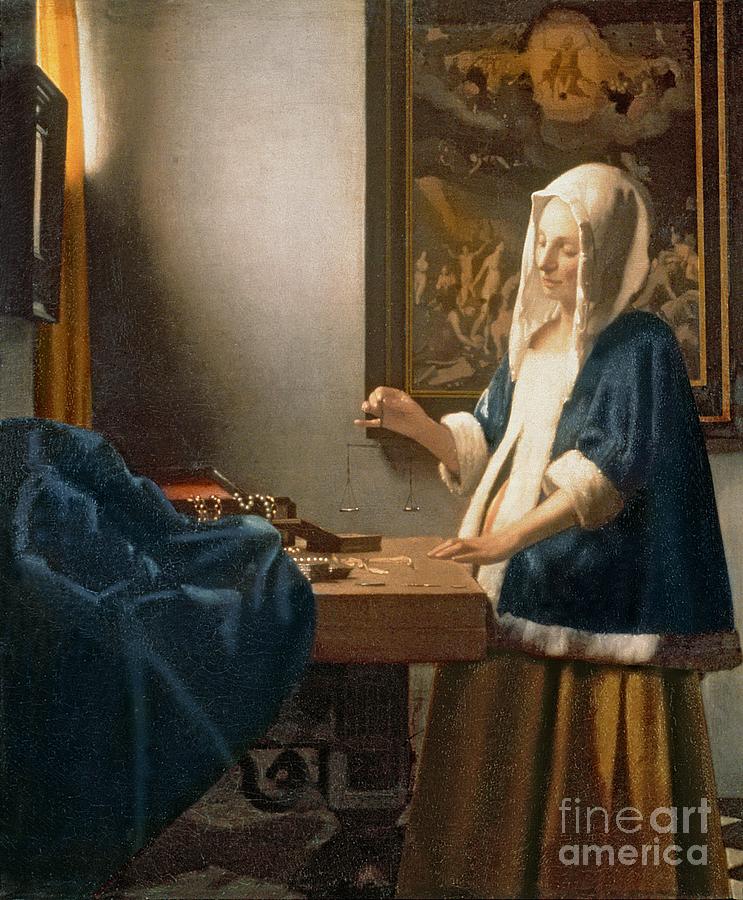
“Woman Holding a Balance”
It looks like the same room. A woman stands in a similar position, facing the window. She’s holding scales, and there are coins and pearls on the table. She seems to be assessing value, weighing the pearls against the coins, maybe? The painting behind her, this time, depicts the last judgement. Christ is also weighing souls. I wonder if the viewer is supposed to be reminded of the Biblical parable about the pearl of great price. Pearls are often used to symbolize purity, so maybe the woman, like Christ, is weighing the purity of the heart. There is a bundle of blue cloth on the table to the left, and I think Vermeer must have enjoyed painting folds in cloth, as cloth seems to be bundled in a lot of his paintings, and often without any real reason. The lovely blue jacket the woman is wearing is also depicted with great care, the colour of the jacket suggesting the colours conventionally given to the Virgin Mary. I really like the woman in this painting. She has a beautiful face, and a very calm and peaceful demeanour. She seems to give an air of purity herself, like the pearls she is weighing.
Only thirty-four paintings are attributed to Vermeer today, a very small body of work compared to some other artists. But each work is exquisite, showing detail, beauty, and humour. Along with Rembrandt, Vermeer is considered one of the greatest painters of the Dutch Golden Age, (usually included in the general European period of Baroque painting). There is a tranquility in much of Vermeer’s work that make them excellent subjects for displaying in your home.
 Eclectic Assemblage