Between 1930 and 1969 Warner Brothers produced Looney Tunes and Merrie Melodies cartoons, during what is regarded as the golden age of American animation. During this time some of the funniest cartoons in animation were made, and the characters have remained popular until today. Directors such as Chuck Jones and voice artists such as the amazing Mel Blanc, as well as the artists, contributed to make these cartoons all-time classics.
A trilogy of cartoons (“Rabbit Fire”, “Rabbit Seasoning”, and “Duck Rabbit Duck”) all proceed along the same lines, but manage to vary the formula enough that each cartoon is still hilarious. Elmer Fudd is out in the woods with his trusty gun. He is ‘hunting wabbits’, and we must be ‘vewy quiet.’ Meanwhile, Daffy Duck, while putting up signs everywhere saying ‘Rabbit Season’ informs us that it is actually duck season, but considers his actions to be survival of the fittest. (I don’t think there has ever been a ‘rabbit season’, given the ability of rabbits to be fruitful and multiply, but on the other hand. Elmer Fudd is not too bright.) The ‘rabbit season! Duck season!’ interchanges are great, ending as they always do with Bugs managing to turn the tables and Daffy getting shot, leading to his beak ending up on the ground, on the top of his head, around the back of his head etc. Of course, if Daffy paid more attention and was less hasty this could have been prevented. In each of these cartoons, there is a point where Bugs tries to misdirect Elmer by cross-dressing. Elmer ALWAYS falls for this, even when he sees Bugs coming up out of his burrow in his outfit. Random absurd moments include – Daffy finding a book entitled ‘1000 ways to cook a rabbit’ in Bugs’ burrow (why!); on mentioning that Elmer has an elephant gun, a random elephant turns up and threatens Elmer (“you do and I’ll give you such a pinch!”); Daffy bringing Bugs to his door with his request ‘can you spare a cup of black-strap molasses’ (random); Bugs informing Elmer “I’m not a stewing rabbit, I’m a fricasseeing rabbit” and going on to say that Elmer must have the correct licence; ‘goat season, mongoose season’ (getting weirder); and my personal favourite, the sign that says “Elmer season.” It is hard to do this justice, but you should really find these and watch them if you haven’t already.

“The Super Snooper” (1951) stars Daffy Duck as a private eye (or, as the cartoon says, ‘private eye, ear, nose and throat’). Daffy does a Bogart-style voiceover in which he says he is in the middle of disposing of his last case. This turns out to be a case of beer, called ‘old hiccup’. He is summoned out to a property where bad things are going on (sirens, shooting and screaming are heard down the phone). The fun starts with the doorbell playing the funeral march when he presses it. A butler answers the door, whom Daffy immediately regards as suspicious (with some justification, as the butler starts by tittering at him in a really weird way.) Daffy concludes that the butler being guilty is way too obvious. We are then treated to a great example of the old ‘walk this way’ gag, where the butler, after saying this, starts to walk in a very strange manner. Daffy shrugs, and follows him in exactly the same way. The stereotypical femme fatale is in residence (“I’m the body, sweetheart,” she tells him in a sultry tone.) He insists she is guilty (without finding out what is happening) and at one point says she has guilt ‘written all over your face’. We see a moment later that yes, she does have guilt written all over her face (in cursive). “Oh?” she asks, bringing out a compact and looking in the mirror. “Hmm,” she adds, and powders it all away. (This is actually my favourite joke of this cartoon.) He continues to fire random questions at her, and she answers “search me” at one point, to which Daffy immediately responds, “Business before pleasure, madam, please!” Given that this is a Looney Tunes cartoon, Daffy manages to get shot at, have pianos fall on him and so forth, all due to his own foolishness. The ‘body’ makes heart eyes at him, tells him he’s cute, and gives him kisses when she can get away with it. Turns out he is in the totally wrong house, and she has been humouring him because she thinks he’s cute. Looney Tunes cartoons included several spoofs on this kind of private detective story, but I think this one may be my favourite.

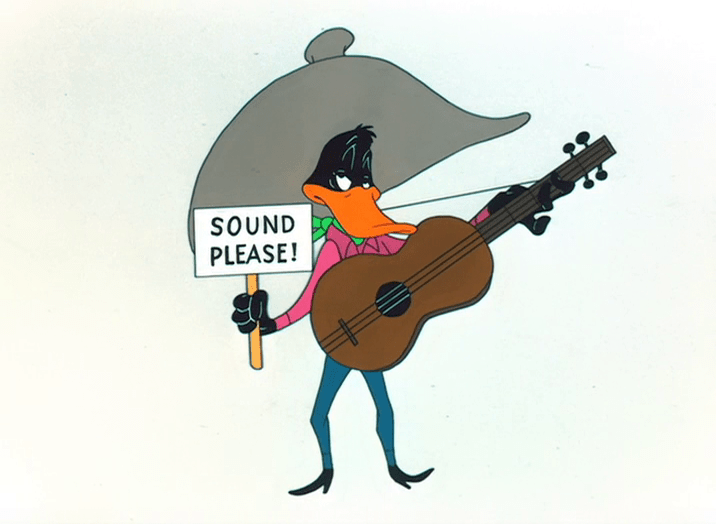
“Duck Amuck” is a classic example of meta-humour. Daffy is trying to do a movie and the ‘animator’ keeps changing things. Initially he tries to keep up:
‘Daffy Duck he had a farm, eeyi eeyi oh. And on this farm he had an igloo ….”
but gets more and more incensed as the cartoon progresses. He is erased, then drawn back in without sound, then when he requests sound what he receives is not the sound he was asking for. He is painted a really bizarre combination of colours, redrawn as a very weird critter with a flower face, and when he gets excited about being put in a navy outfit, he is promptly ducked in the ocean, followed by some creative interpretations on the meaning of ‘close up’. The ending has Daffy screaming ‘who’s responsible for this’, when we finally see the artist. Unsurprisingly, it is Bugs Bunny.
“One Froggy Evening” has none of the usual characters but is no less funny for this. A man working on a site that is demolishing an old building, finds buried in the foundation a box, in which there is a singing frog. He has a little top hat and a cane, and dances and sings. The man immediately thinks he will make a fortune from the frog, until he discovers one small problem. The frog will only sing when no one else is around. There are a number of fun comments made about people in this cartoon. The man at the centre of the story, only thinks about using the frog for fame and fortune. When he hires a theatre and tries to get people to come, they will only come in when he puts up a sign saying ‘free beer’, upon which he is trampled by the incomers. After losing everything, and even ending up in an asylum for a while, the man, seeing a new building being constructed, tosses the box with the frog inside into the foundations. (We now know why he was in the foundations to start with). Roll on 2056, and the new building, now an old building, is being demolished. A man finds the singing frog (who is apparently immortal) and the whole cycle starts again. This one isn’t really a laugh out loud kind of cartoon, but I think it is very clever.

“The Three Little Bops” retells the story of the three little pigs, but with a jazz music setting. The ‘three little bogs’ are jazz musicians, playing at the House of Straw, when they are approached by the big bad wolf. He thinks they’re great and wants to join the band. This is when they discover that he cannot play. The story progresses as per usual, until when the wolf discovers he can’t blow the House of Bricks down, he decides to blow it up. This leads to him blowing himself up instead, only to discover in hell that he can play after all. “You’ve got to get hot to play real cool,” says one of the pigs, as they decide they’re going to let the ghost wolf join the band. Honestly I mostly like this one, not because it’s very funny, but because it’s really bizarre. It’s a very clever reinterpretation of the fairy tale.

“What’s Opera, Doc” is often regarded as being the best of the Looney Tunes cartoons. Bugs Bunny and Elmer give us their interpretation of Wagner, and the result is just as insane as you might expect. I don’t know how the voice artists were able to keep the voices and sing, on tune, as well, but they manage. Elmer sings to us that he’s hunting wabbits, and when he finds a rabbit hole, he starts stabbing into it with his spear, singing “kill de wabbit!” while he does so. Bugs, on arrival, scoffs at Elmer’s assertion he will use his ‘magic helmet’ to help him, until Elmer demonstrates by summoning a thunder storm, whereupon Bugs runs off. Opera or not, it wouldn’t be a Bugs and Elmer cartoon without cross dressing, so enter Bugs as ‘Brunhilde’, riding a very fat and bored looking horse. They even do a little ballet and sing a duet (I told you it was insane). Elmer summons his magic storm to ‘kill de wabbit’ including “typhoons, hurricanes, earthquakes … SMOG!!” The background in this cartoon is very reminiscent of stage sets for Wagnerian opera at the time it was made, very expressionist. Elmer apparently succeeds in killing de wabbit, immediately regretting his action, though Bugs does revive momentarily at the end to say, “Well, what did you expect in an opera, a happy ending?”

My all-time personal favourite of these cartoons is “The Rabbit of Seville”, and if you watch nothing else, I urge everyone to watch this. It is absolutely hilarious. Elmer Fudd is trying to shoot Bugs Bunny (again), chasing him into a theatre and right onto a stage. A sign indicates that “The Barber of Seville” is playing. The curtain goes up (thanks to Bugs), and the conductor in the orchestra pit, a little perplexed about the show starting early, shrugs and begins to conduct. Thus begins an ‘opera’ that is like nothing you’ve ever seen, with the correct operatic music being put to a use which would have left its original composer very surprised (and possibly horrified). Bugs, playing the ‘barber’, whisks Elmer into his shop and into his chair. Absurdist humour abounds. Bugs raises his razor with a manic look in his eye as if Elmer is about to be murdered, and then sings “There, you’re nice and clean, although your face looks like it might have gone through a machine”. Elmer’s outrage leads to Bugs reverting to the cross-dressing technique again, and again, Elmer falls for it … at least until he sees Bugs’ furry tail sticking out the back. An attempt to shoot him fails as Bugs has tied Elmer’s gun in knots, blowing Elmer right back into the barber chair and dazed. Bugs’ dead-eyed look during the next sequence is just as funny as what is happening, a head massage where he uses hands, then feet, wipes his feet on Elmer’s head, and then proceeds to mix a salad on his bald head. After another chase scene, Bugs gets Elmer back in the chair (courtesy of a sandbag) and puts hair restorer on his chin, mowing off the resulting beard with a tiny lawn mower, puts hair tonic on his head and follows this up with fertilizer. So Elmer is initially delighted to see hair growing on his head, but not so delighted when he suddenly sprouts flowers. A final chase involves a priceless example of escalating hostilities until Bugs defuses the situation with … a very unexpected ending. This cartoon is hilarious, bizarre, absurd and chaotic. It has all the best elements of Looney Tunes.

The Looney Tunes and Merrie Melodies cartoons of this era were, at their best, absolutely insane. The left-field humour and ridiculous situations meant for some hilarious moments. The writers, artists, and directors, came together to create something truly one of a kind, combining verbal and visual humour, superbly drawn characters and backgrounds, music and sound effects, and the voices. I grew up with these cartoons, and they always serve to make me laugh all these years later.
 Eclectic Assemblage